June 16, 2026 — Berlin, Germany
At the EPIC Technology Meeting on Photonics for Quantum Technologies, hosted at Fraunhofer HHI in Berlin, Jérôme Prieur, co-founder and CEO of AUREA Technology, presented the company’s vision for the photonic technologies required to move quantum communications from experimental demonstrations toward scalable industrial networks.
His presentation, “Essential Photonics Building Blocks for Scalable Quantum Communications,” focused on one of the industry’s central challenges: future quantum networks will require not only higher photonic performance, but also compactness, reliability, interoperability and manufacturing scalability.
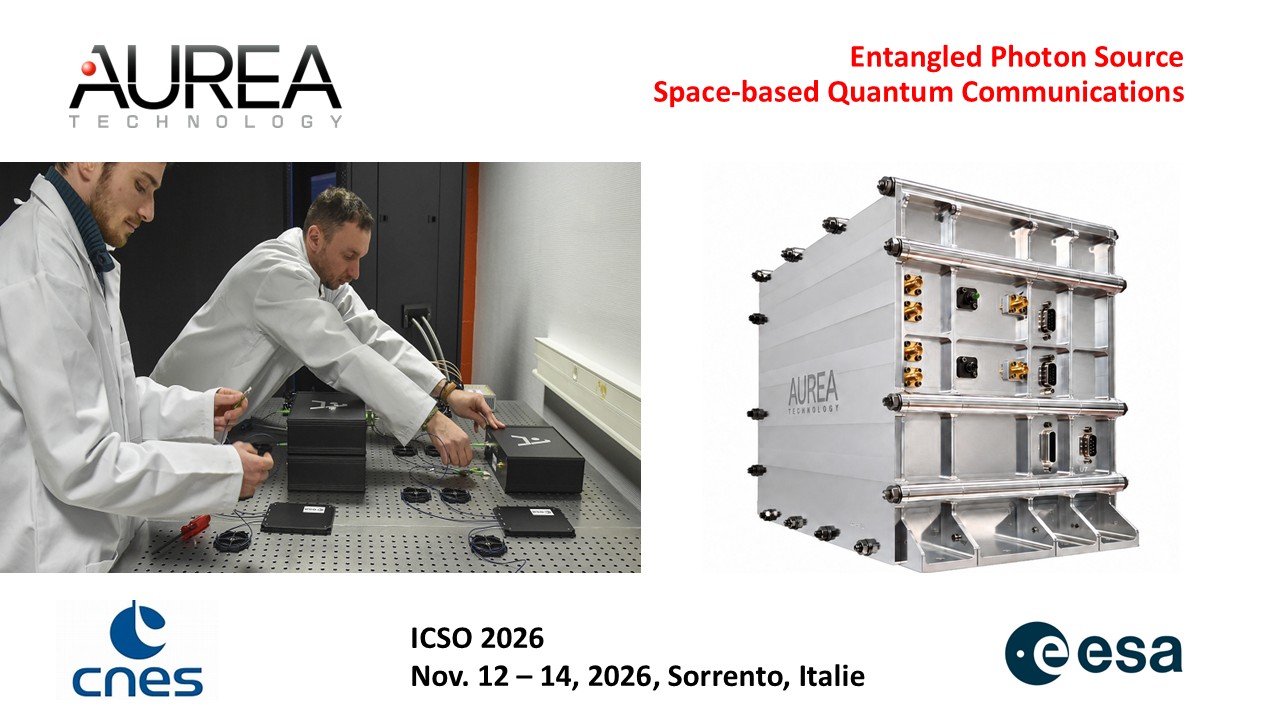
Under Jérôme Prieur’s leadership, AUREA Technology has progressively built a portfolio covering several of the critical photonic functions required in quantum systems: single-photon detection, picosecond timing, entangled-photon generation and ultrafast pulsed lasers.
“Quantum technologies are reaching a stage where system architecture and industrial integration matter as much as laboratory performance,” said Jérôme Prieur. “Our role is to provide system integrators with high-performance photonic building blocks that can be integrated, qualified, manufactured and deployed at scale.”
The presentation highlighted the importance of moving from individual laboratory instruments toward integration-ready modules and rack-level architectures, particularly for telecom quantum networks and future space-to-ground quantum communication infrastructures.
Jérôme Prieur also emphasized the strategic role of a strong European photonics supply chain. Quantum infrastructure will increasingly depend on trusted and locally supported sources, detectors, timing electronics, control systems and manufacturing capabilities.
Since co-founding AUREA Technology, Prieur has driven a strategy centered on turning advanced photon-counting technologies into commercially deployable products, with a particular focus on applications where performance must be combined with industrial reliability.
The EPIC meeting brought together leading companies, research institutions and technology developers working on the future of quantum photonics and provided an opportunity to discuss the technical and manufacturing challenges that must be solved before large-scale quantum networks can be deployed.